
For electronics manufacturers and EMS providers, component management is no longer simply about knowing how many reels are stored in a warehouse. A modern material-control system needs to identify each reel, determine its remaining quantity, track its location, and connect this information with production requirements.
This is why automated counting technology is increasingly being combined with intelligent storage. An electronic component reel counter can provide a reliable quantity-confirmation step between receiving, storage, production preparation, and material return.
Seamark ZM combines X-ray SMD component counting equipment with EMS Component Smart Storage solutions, creating technologies for more connected and traceable electronic component management.
Traditional component warehouses rely heavily on operators to identify reels, record quantities, select storage locations, and prepare materials for production. As the number of part numbers and reels increases, manual management becomes increasingly difficult.
A smart storage system can associate each reel with information such as:
Part number and reel ID
Component quantity
Storage location
Material status
Work-order information
Retrieval and return history
The component reel counter is especially useful when the quantity remaining on a reel is uncertain. Instead of relying on an operator's estimate, an automated counter can provide a measured quantity that can be connected with the inventory record.
This creates a direct link between physical materials and digital inventory.
An x ray reel counter uses X-ray imaging to determine the quantity of components on a reel without requiring individual components to be removed and counted.
Seamark ZM describes its online reel counter as an X-ray counting machine for SMD components, using X-ray imaging and software algorithms to calculate component quantities on reels.
This approach is particularly useful for small components packaged in carrier tape. Opening packaging for manual counting creates additional handling and may be impractical when large numbers of reels must be processed.
For industrial warehouses, the real value is not simply faster counting. It is the ability to introduce a standardized quantity-verification step into the material workflow.
A component counter machine can be positioned at several important stages of an automated material-management process.
When materials arrive, the warehouse needs to verify that physical quantities correspond with purchasing or receiving information.
The reel can be identified and counted before being assigned to a storage location. If the measured quantity differs from the expected quantity, the discrepancy can be investigated before the material enters available inventory.
After quantity confirmation, the reel can be assigned to an appropriate storage location.
Seamark's EMS Component Smart Storage solution includes intelligent material racks and material towers. Its material tower supports 7-inch, 13-inch, and 15-inch reels and can be integrated with the company's material-management system.
Counting and location management therefore become connected processes rather than independent warehouse tasks.
Production orders often require multiple component types. Locating the correct reels and preparing them for production can consume significant operator time.
Seamark states that its intelligent material rack supports electronic-label and light-guided picking and can handle multiple work orders simultaneously.
In this workflow, the electronic component counter becomes part of a larger material-preparation system.
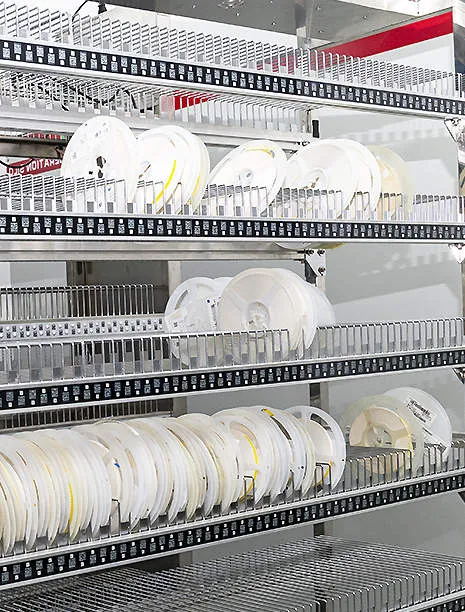
Production frequently leaves partially used reels. Their remaining quantities may differ significantly from the original receiving records.
Recounting a returned reel before putting it back into storage allows the inventory system to update the actual remaining quantity. This creates a closed-loop process:
Receive → Count → Store → Retrieve → Production → Return → Recount → Update Inventory
A manual SMD reel counter can still be appropriate for small warehouses, engineering departments, or occasional counting tasks.
However, manual processes require operators to perform loading, identification, counting, recording, and storage operations. The number of manual steps increases as material volume grows.
An automated counter machine online can reduce operator intervention and connect counting with other material-management processes.
When evaluating manual versus automated equipment, manufacturers should consider:
Number of reels processed daily
Number of component types
Frequency of material returns
Required inventory update speed
Labor requirements
Need for automated handling
Traceability requirements
Software integration
For high-volume EMS operations, automation should be evaluated at the workflow level rather than only at the counting stage.
A standalone component counter produces a quantity. A connected counting system can turn that quantity into useful inventory data.
Seamark describes its online reel-counting solution as supporting MES data uploading and automatic material-label printing.
A typical digital workflow can therefore follow this sequence:
Material Identification → Counting → Quantity Confirmation → Labeling → Storage → Work-Order Retrieval → Production → Return
The exact interfaces depend on the customer's ERP, MES, WMS, or warehouse-control architecture. However, the objective is consistent: physical material movements should correspond with digital inventory events.
This helps reduce the gap between recorded inventory and actual material on hand.
Counting alone does not solve every warehouse-management problem. Manufacturers also need to know where materials are located and which reel should be retrieved.
Seamark's EMS Component Smart Storage solution includes intelligent racks, material towers, and automated storage concepts. The company also identifies FIFO-oriented material management and error-proof material handling as part of its smart warehouse approach.
For manufacturers managing large numbers of similar-looking reels, controlled retrieval can reduce the possibility of selecting an incorrect material.
The combination of an electronic component reel counter and smart storage therefore addresses two fundamental questions:
How much material is available?
Where is the correct material located?
Electronic component inventory data can become part of broader production and quality records, particularly when manufacturers have customer-specific traceability requirements.
A robust system should be capable of recording relevant information such as material identification, quantity, transaction time, storage location, and operator or system activity.
However, a reel counter machine does not automatically make a company compliant with a particular quality standard. Manufacturers still need appropriate procedures for data retention, access control, material identification, calibration, and inventory management.
The equipment should support these procedures and provide consistent, traceable information.
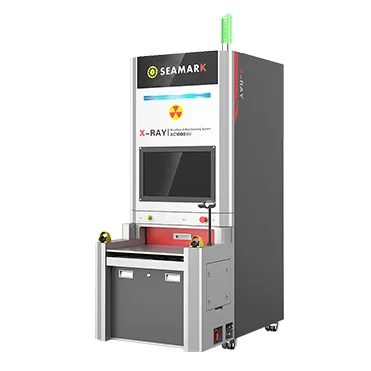
When selecting an electronic component counter, manufacturers should evaluate the complete application rather than focusing only on counting speed.
Important factors include:
Check whether the system can handle the component sizes, reel formats, and material types used by the facility.
Determine whether reels will be loaded manually or through carts and automated material-handling equipment.
Evaluate compatibility with existing MES, ERP, WMS, or warehouse-control systems.
Automatic labeling can reduce repeated manual data entry and maintain material identification after counting.
The counter should fit naturally into the company's planned storage and material-flow architecture.
For industrial operations, installation, training, maintenance, software support, and spare-parts availability should also be considered.
Seamark ZM combines X-ray counter technology with EMS Component Smart Storage solutions.
Its smart-storage portfolio includes intelligent material racks, material towers, and automated storage systems. The company also offers online and offline SMD component counting equipment for different material-management requirements.
By connecting counting, identification, storage, retrieval, and production preparation, Seamark ZM supports manufacturers moving from conventional reel storage toward more automated and traceable material management.
The role of an electronic component counter is expanding beyond simply determining how many components remain on a reel.
In a modern EMS warehouse, counting can become part of a connected workflow covering receiving, identification, storage, production preparation, material return, and inventory updating.
An X-ray reel counter provides the quantity-confirmation function, while intelligent storage systems manage physical locations and retrieval. When these technologies are connected with digital production and warehouse systems, manufacturers can establish a more consistent and traceable approach to component management.
For electronics manufacturers seeking higher levels of warehouse automation, the combination of online reel counting and smart component storage provides a practical foundation for transforming physical inventory into controlled digital material information.
An electronic component reel counter is equipment designed to determine the quantity of components remaining on a reel. Automated systems can use X-ray imaging or other sensing technologies to calculate quantities without manually counting individual parts.
An X-ray reel counter uses X-ray imaging to obtain information about components inside a reel and software algorithms to calculate the quantity. Seamark ZM's online reel counter is designed specifically for SMD component counting.
Yes. Counting information can be connected with storage and inventory systems. Seamark's EMS Component Smart Storage solution is designed to work with intelligent racks, material towers, and automated storage processes.
Manual counting requires more operator involvement in loading, counting, recording, and material handling. Automated counting can reduce these manual steps and support integration with digital inventory systems.
FIFO helps warehouses control the sequence in which materials are stored and retrieved. It can support material rotation and reduce unnecessary selection errors.
Seamark states that its online reel-counting solution supports MES data uploading and automatic material-label printing. The specific integration method should be determined according to the customer's software architecture.
No. An X-ray inspection machine is generally designed to examine internal structures or defects, while an X-ray component counter is specifically configured to determine the quantity of components on reels or packaged materials.
 EN
EN
 es
es  ko
ko  de
de  it
it  pt
pt  th
th  ar
ar  pl
pl  vi
vi  tr
tr  ru
ru