
BGA packages have become essential in modern electronics because they provide high I/O density while reducing package size. However, when a BGA component fails, replacing it is considerably more demanding than repairing a conventional surface-mount component. The solder joints are hidden underneath the package, and improper heating, positioning, or cooling can damage both the component and the PCB.
For electronics manufacturers, EMS providers, repair centers, and industrial electronics service companies, choosing the right BGA rework stations is therefore a process-engineering decision rather than simply an equipment purchase.
The right solution must match PCB dimensions, package types, production volume, thermal requirements, alignment accuracy, operator skill, and quality-control procedures. Seamark ZM offers a range of BGA rework systems covering manual, semi-automatic, and fully automatic configurations, allowing manufacturers to select equipment according to their production requirements.
BGA reworking involves removing a defective BGA, preparing the PCB surface, positioning a replacement component, and creating reliable solder joints through a controlled thermal cycle.
The difficulty lies in controlling several variables simultaneously. The solder must reach the required reflow temperature, but the PCB substrate and surrounding components must remain within acceptable thermal limits. Excessive heating may cause PCB warpage, pad damage, component degradation, or delamination.
A professional system therefore needs more than a heater. Important functions include programmable temperature profiles, multi-zone heating, real-time temperature monitoring, controlled cooling, component alignment, and repeatable placement.
For high-reliability production, these functions turn BGA repair from an operator-dependent activity into a controlled manufacturing process.
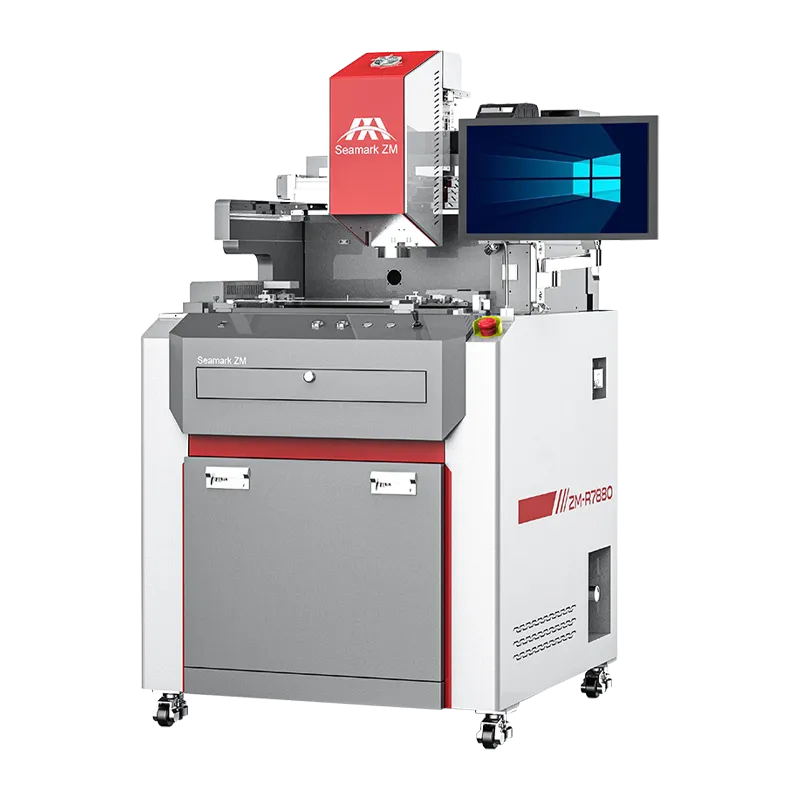
Different BGA rework systems use different heating and alignment technologies. The two common approaches are hot air convection and infrared heating, while some industrial systems combine multiple heating methods.
A hot air BGA rework station transfers heat through controlled airflow. It is familiar to many technicians and can provide localized heating through interchangeable nozzles. However, airflow must be carefully controlled because excessive turbulence can affect nearby small components.
An IR BGA rework station uses infrared radiation to heat the target area. IR heating can provide efficient energy transfer and is particularly useful for larger boards and applications requiring controlled heating over a defined area.
Hybrid configurations can combine hot air with infrared or large-area preheating. Seamark ZM's ZM-R5860, for example, uses top and bottom hot-air heating together with a large-area infrared heater, providing a solution for professional BGA repair applications.
The best technology depends on the board, package, thermal mass, and production process rather than on a single universal heating method.
Heating is only one part of the process. Placement accuracy is equally important.
BGA technology relies on an array of solder balls positioned beneath the package. If the replacement component is not correctly aligned with the PCB pads, the resulting solder joints may be open, bridged, or otherwise unreliable.
Modern BGA rework equipment can use CCD or other optical alignment systems to display the relationship between the component and PCB pads before placement. This reduces dependence on visual estimation by the operator.
For applications involving fine-pitch packages, high-density boards, or expensive components, optical alignment becomes increasingly valuable.
Seamark ZM's product range includes optical-alignment equipment as well as fully automatic systems. Its ZM-R8650C, for example, uses high-definition visual alignment and automatic component pickup and placement, targeting large boards such as server motherboards and 5G communication boards.
A BGA rework station automatic configuration is most useful when manufacturers require repeatability, reduced operator intervention, and standardized processes.
Manual equipment may remain practical for low-volume repair shops, engineering laboratories, and occasional maintenance. Semi-automatic equipment is suitable when technicians still need process flexibility but require improved alignment and temperature control.
Fully automatic equipment becomes more attractive when:
BGA repair is performed frequently
Boards have high replacement costs
Multiple operators need to achieve consistent results
Large or complex PCBAs are being repaired
Production records must be maintained
Repeatability is more important than minimum equipment cost
The ZM-R8650C from Seamark ZM supports PCB sizes up to 660 × 600 mm and provides eight temperature measurement interfaces for real-time thermal-profile recording. It also supports components ranging from approximately 1 × 1 mm to modules up to 100 × 100 mm.
This type of configuration is better suited to industrial environments than a basic benchtop repair system.
The ideal BGA repair station depends heavily on the application.
Smartphones, tablets, gaming equipment, and compact consumer electronics often contain densely packed components. Equipment with precise optical alignment and controlled localized heating can be valuable because adjacent components may be highly sensitive to thermal exposure.
For these applications, manufacturers may prioritize compact or precision-oriented equipment rather than maximum PCB capacity.
Automotive ECUs, control modules, sensors, and power electronics require highly repeatable repair processes. Thermal management is particularly important because PCB assemblies may use heavy copper, large thermal masses, or complex multilayer structures.
In this environment, programmable temperature profiles and traceable process parameters can help standardize repair operations.
Large server motherboards and communication boards create different challenges. PCB dimensions, component size, and thermal distribution become more important than compact workstation size.
Large-board equipment such as the Seamark ZM-R8650C is designed for applications including 5G communication boards, server motherboards, and other large PCB assemblies.
Industrial controls, instrumentation, aerospace-related electronics, and other high-value assemblies often justify higher levels of process control because a failed repair can result in significant downtime or product loss.
In these applications, equipment selection should consider not only repair capability but also data recording, maintenance, calibration, operator training, and quality documentation.

Searching for BGA rework station price can be misleading because two machines with similar appearances may have very different capabilities.
The final equipment cost can be influenced by:
Heating architecture
Number of independent heating zones
PCB working area
Optical alignment system
Automation level
Placement accuracy
Temperature-control hardware
Software functionality
Camera and imaging configuration
Vacuum pickup system
Accessories and nozzles
Customization requirements
Installation and after-sales support
A low-cost manual machine may be sufficient for occasional repairs, while a fully automatic system can provide greater productivity and repeatability for industrial production.
Therefore, buyers comparing a BGA rework station for sale should evaluate total process capability rather than selecting equipment based solely on the initial quotation.
Although the rework station controls the repair process, manufacturers may still need independent inspection afterward.
BGA X-ray inspection equipment can examine hidden solder joints beneath BGA packages without removing the component. This makes X-ray BGA inspection useful for verifying whether a reworked assembly contains issues such as voids, insufficient solder, bridging, or open connections.
The inspection result can also provide feedback to the rework process. If recurring defects appear in the same location, engineers can investigate thermal profiles, alignment, solder materials, PCB design, or operator procedures.
Seamark ZM provides both BGA rework equipment and microfocus X-ray inspection systems, enabling manufacturers to consider rework and verification as complementary parts of a PCBA quality-control workflow.
For B2B electronics manufacturers, equipment compliance should be considered before purchasing a machine.
A rework station should be evaluated for electrical safety, thermal safety, emergency controls, equipment documentation, and applicable regional requirements. For companies operating under formal quality-management systems, process documentation and operator qualification may also be required.
More importantly, manufacturers should establish standardized rework procedures. These can define acceptable temperature profiles, component handling, PCB preheating, alignment tolerances, inspection requirements, and post-rework verification.
Where customer or industry requirements demand traceability, temperature data and repair records should be retained as part of the manufacturing-quality documentation.
The equipment itself cannot guarantee compliance; manufacturers must verify the exact certifications, configuration, installation requirements, and applicable local regulations for their facility and market.
There is no single best BGA rework station for every manufacturer. A practical selection process should begin with the application rather than the machine model.
First, define the largest and smallest PCB and component sizes. Next, determine whether the process requires manual, semi-automatic, or fully automatic operation. Then evaluate heating technology, alignment precision, temperature measurement, cooling control, and software capabilities.
For large industrial boards, an automatic optical-alignment system may provide greater value than a compact manual machine. For repair laboratories, a smaller system may offer better cost efficiency. For high-volume production, automation and data traceability can have a greater impact on total operating cost than the initial purchase price.
Seamark ZM's broad portfolio—from hot-air and infrared equipment to optical and fully automatic BGA rework systems—allows buyers to compare configurations according to their actual process requirements.
A BGA rework station is designed to remove defective BGA components and install replacement components under controlled heating and alignment conditions. Professional systems can also support temperature profiling and automated placement.
Neither technology is universally better. Hot air offers localized heating and familiar operation, while infrared can provide efficient and controlled heating over a defined area. Board size, component density, thermal mass, and process requirements should determine the choice.
A conventional soldering station is generally designed for accessible solder joints. A BGA rework station is specifically engineered for hidden BGA connections and typically provides controlled heating, alignment, placement, and reflow functions.
The required accuracy depends on package pitch and PCB design. Fine-pitch BGA applications require much tighter alignment than larger packages, which is why optical alignment systems are valuable in professional BGA rework.
Not every repair requires X-ray inspection, but it is highly useful when solder joints are hidden and visual inspection cannot confirm joint quality. X-ray can provide additional verification after BGA rework.
A mini system can be suitable for small PCBs, laboratory work, prototyping, or low-volume repair. High-volume or large-board manufacturing generally requires greater heating capacity, working area, automation, and process monitoring.
Buyers should evaluate heating technology, alignment accuracy, PCB capacity, supported component sizes, temperature-control capability, automation level, certifications, documentation, spare parts, training, warranty, and after-sales technical support. Equipment specifications should be matched to the actual PCB and BGA packages being processed.
 EN
EN
 es
es  ko
ko  de
de  it
it  pt
pt  th
th  ar
ar  pl
pl  vi
vi  tr
tr  ru
ru